4 Steps to Flesh Out Your Book
Dec 19, 2025
If your writing feels bare, your plot doesn't feel deep enough, or your characters feel like NPC's instead of real people, don't worry! There's a pretty easy fix to this, and in today's blog post, I'll walk you through exactly how to do it.
Many of my students come to me worried that their book premises just aren't good. They feel like their work is floppy or insubstantial, and most of the time they're on the edge of deleting everything and trying again with a different project.
Here's the thing, though: most of the time, there's nothing wrong with the story. It just needs a little redirection to get things on the right track.
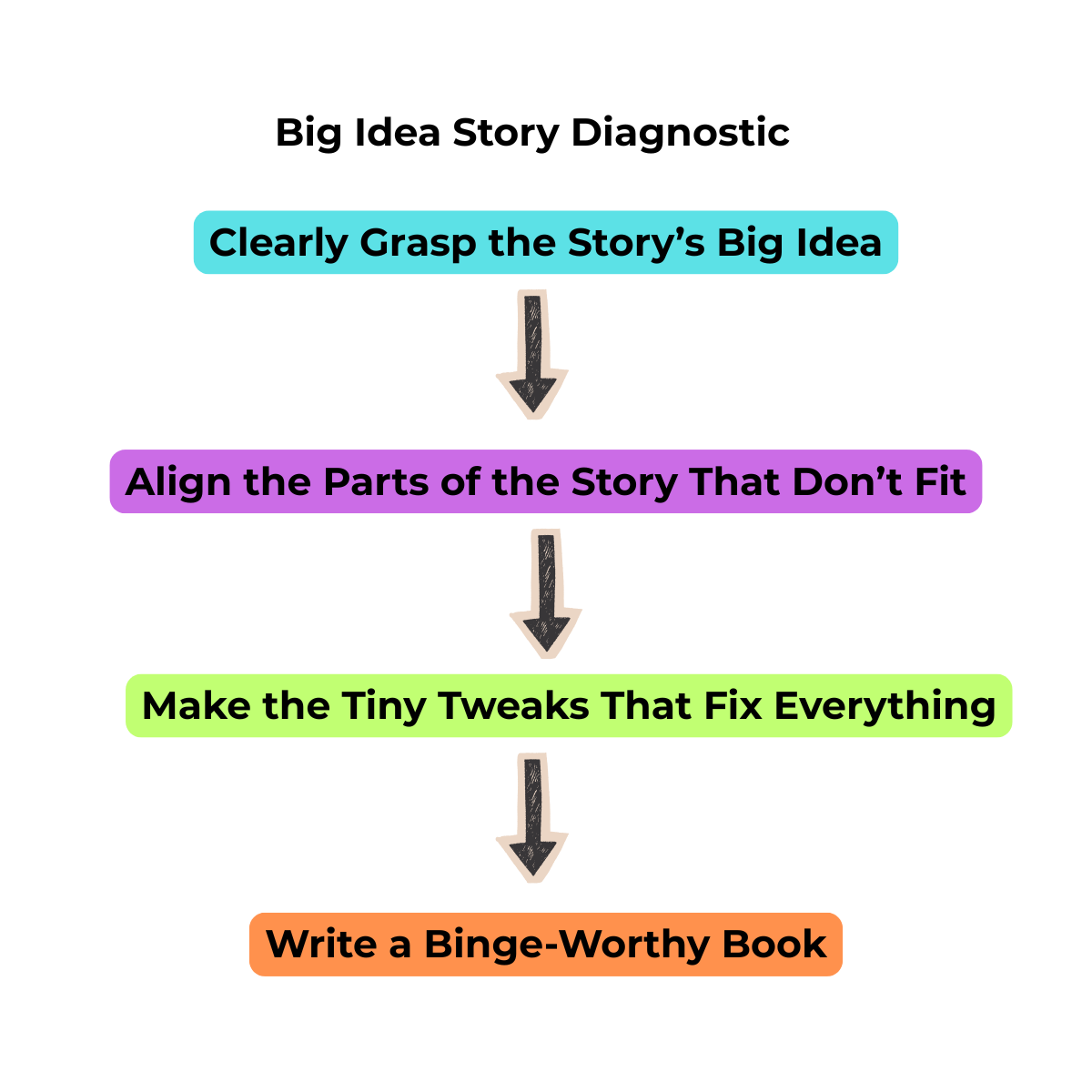
Follow the steps below to redirect your work and double check if you need to scrap it and start over, or if you just need a few tiny tweaks (and I'd bet it's the latter).
(by the way, this is waaaaaaay easier with my Big Idea Diagnostic Worksheet. Want to download for free? Click here)
Step One: Revisit the Core Theme of Your Book
It's really difficult to flesh out a book when it's not saying anything important. That's why the first thing I want you to do is figure out the most important part of your book:
What the heck do you even want to say?
This doesn't have to be preachy or life-changing, but it DOES need to be worth your reader's time. Afterall, why would someone read something if they don't get anything out of it?
You might think, it's for the entertainment, but in reality, even THAT isn't a good enough reason. Here's what I mean:
Last night, I was feeling really depressed. I've not had a good week. Things have been rough. BUT I remembered that the newest Knives Out mystery had just dropped on Netflix, so I cuddled up on the couch with my husband and my cat to watch it. I did this for a few reasons:
1: I remembered loving the first two Knives Out films. I love mysteries, especially the "locked door" type (which are supposed to be unsolvable).
2: my original love of these movies made a promise to me that I would like this third installment as well.
3: what I needed was the fulfillment of the promise: not just to be entertained, but to be rewarded for watching something new by forgetting what was bothering me that day.
It's just a tiny tweak in how we think about storytelling, but it's a crucial one. Why did I need entertainment the other day? Because I was feeling bad. This movie promised to help me feel less-bad by distracting me with a gruesome murder mystery.
(side note: it totally worked. The movie was great!)
To apply this to your work: circle back to the main theme of your book. You can figure it out by asking a few crucial questions:
1: what is it you truly want to say?
So in my work, one of the most important themes is absolution and redemption. This is important for me, because I know what it feels like to feel like you’ve screwed something up so badly that you’ll never be able to fix it. I want my readers to know that’s not true, and there’s always redemption from even your worst mistakes.
But...you probably haven't read my work yet, so here's a real-world example from something you probably have seen:
In Macbeth (just floating around in the back of my head) one of the big ideas is power: how it corrupts, how it destroys, and how desiring power must be dealt with very carefully. Otherwise, we see how Lady Macbeth and Macbeth himself spiral into insanity and eventually death. Not good.
Shakespeare’s audience was wide and varied, but it’s likely that at least some of them watching would have understood this grasp for power and perhaps he was pointing fingers at certain audience members. Who’s to say?
2: whatever it is you're trying to say, why is it important that YOU say it?
We all have life experiences and beliefs that guide our thinking and reactions to the world. Your perception of the world is going to be different than mine, even if it's just by a few degrees. That's one of the cool parts of being a human being.
So do some thinking on why YOU must tell this story, and why it's just not good enough to let someone else tell it. This is more for you to figure out how to keep yourself writing when you want to quit, but I promise, it's extremely important in the long run.
3: who needs to hear this right now?
Basically, who is your audience? What are they looking for? Can you make them a promise and then keep it when you tell your story?
In the case of this blog post, I know exactly who this tutorial is for: writers who have a really good story but lack just a few small things they need to tell it (i. e., you). That makes it really easy for me to write an effective blog post, because I know exactly what you need, and at the beginning of the post, I promised to give it to you (and I actually can!).
In the case of Wake Up Dead Man (the Netflix Movie I just told you about), Rian Johnson knows that his audience need a gruesome, impossible murder mystery to keep them engaged for a while. He makes a promise (if you love murder mysteries, you'll love this!) and he delivers on the promise.
So who is your audience? What do they need? What promise can you make them? (Example: if you read this book, I'll give you your favorite trope, enemies-to-lovers, by the end of the book). Write that in your notes. That will keep you grounded as you continue to explore your book.
4: are there any subthemes or related messages that are also important to the story?
Maybe you've got your Big Idea hammered home, but it still feels a little bit flimsy. What messages or subthemes could you add to SUPPORT the big idea you're trying to communicate?
An example I like from Star Wars makes this pretty clear. It's obvious in Star Wars that good triumphs over evil. That's sort of the entire point. However, there are several subthemes in there that nuance this idea even more:
- Good triumphs over evil, but sometimes, choosing "good" can be really difficult. We see this with the major protagonists: Anakin, Luke, Rey, Kylo-Ren, they all struggle with choosing the light side (or the dark side, depending on who you look at) when things get hard. Situations get challenging. Sacrifices have to be made. Yes, good is GOOD, but staying good can be tough.
- You might lose everything: let's be honest, the "good guys" get shanked a lot in these films. They lose a LOT. Let's look just at Rogue One: A Star Wars Story. Everyone in this movie dies (sorry, spoilers) for the greater good. Does that mean that "good" isn't good? Nope. It means that it's that much more valuable.
- It can be difficult to see what "good" is: a lot of the time, the good or right choice can be confusing. This is true both in fiction and in reality. People lie. Conflicts arise. Truth can be difficult to find. Does it mean it doesn't exist? No. But it means we have to work that much harder to make the right decision.
What all of these subthemes do is really important: it points to different parts of the message that resonate with your reader/viewer. Basically, your audience sees this, and goes, "wait! I know what that feels like!" Because they can relate to it, it becomes something that they truly treasure and enjoy.
When I was watching Wake Up Dead Man the other night, I couldn't really relate to Benoit Blanc, mostly because I'm not a genius, crime-solving celebrity detective. I'm not a man from the deep south. We don't have that much in common.
But I could relate to the disgraced priest, who was on the verge of losing himself in the crime chase, and was fighting the entire movie to hold on to his entire sense of identity. That really resonated with me, and it's the reason I stuck with the movie the entire way.
Side note: sometimes it can be difficult to work on this part of your book if you're struggling to believe in your writing. Check out this article that will help you with that.
Step Two: Now that you have your Big Idea, go through what you've already written and find places where your idea already resonates.
This is not a "fix-everything" moment for your book. I want you to go and diagnose how your book is already doing.
You've got your big idea, so go find evidence for it in your book! Think of it like a treasure hunt: it's likely that you've already started including these themes in your book, even on a subconscious level. We writers rarely have nothing to say. We just need a little bit of clarity when we try to say it, and that's the purpose of Step Two.
If you’re struggling to find any, look at what you’ve written so far and ask: can I possibly tie this to the “big idea” with just a little bit of tweaking? Then brainstorm those ideas off to the side in a separate document.
If this part is difficult for you, I highly recommend downloading my free Big Idea Diagnostic. It's built for this exact problem. Click here to get it!
Step Three: make the big idea clear in the REST OF THE BOOK
This is your permission to start adding things to your book. BUT, only do this once you've properly diagnosed whether or not your Big Idea is already relevant in the rest of your story.
The very last thing I want you to do is start adding stuff simply for the sake of adding it. That's pointless and will probably make your book worse. Once you've got a focused direction for your book, THEN and only then do you start adding things to it, a little bit at a time.
Some things to think about while you're adding:
Does your main character already embody what you want to say? For example, are they heroic? Do they embody hope? Or do they have to go through a significant character arc to LEARN the big idea? (this is typically the hero’s journey, by the way)
My favorite example of this is in How to Train Your Dragon, where Hiccup shows the other Vikings in his village that dragons aren’t evil. Fun fact: I have seen that movie 62 times in my life. I can quote it word for word.
This is the first area you can start fleshing out your book. Your character’s story can and should point to your BIG IDEA, so work here, until they go on an arc where either THEY LEARN what it is, or they show other people what it is.
Perhaps it’s a rural town where it’s easy for everyone to know everyone’s business, and this is where your MC learns about gossip. I dunno.
I’m currently watching Gravity Falls with my husband for the first time (I’m behind the ball, I know) and the backdrop of the small town creates a perfect stage for weird and wild things to happen, partly because it’s so rural, and partly because who else in the world cares what happens in a small town? That’s why nothing that happens there is noticed anywhere else.
Perhaps it’s a city, where the MC herself doesn’t seem noticed by the great happenings around her. What does she learn about learning to accept herself in a world that makes her feel invisible? I dunno, you can really play around with that.
Start with your characters. Their actions and choices should either highlight or contrast with the big idea.
Now that your characters are good, work on your setting. What does your setting say about the Big Idea? Like your character, your setting should either highlight or contrast with your Big Idea.
Step Four: Tweak the plot (maybe)
Lastly, I’m gonna have you tweak the plot.
If you haven't outlined your book before, I highly recommend starting now. Use my Ultimate Plotting Toolkit to make this 100x easier.
Once you’ve got your characters, your big idea, and your setting all sorted out, go through your manuscript and start adding plot points that either:
- Highlight the big idea of your book (so they draw the characters closer to it)
- Or contrast with the big idea of your book (perhaps they create conflict or become a red herring for your big idea)
Either way, make sure that when you’ve added something it raises the stakes and creates urgency for your main character to LEARN the big idea of your book.
THIS IS HOW YOU WILL KEEP YOUR READERS HOOKED TO THE VERY END.
I save this one for last, because most of the time, you don’t really need to add “more stuff” to a story, and if you add more stuff before you’ve worked out your big idea, it will likely just feel scattered and disconnected.
The truth is that the length of the book isn’t super important at this stage, because you’re not going for a work count. You’re going for depth and complexity, which happens only when you truly have something to say.
So go through these steps to fully flesh out your manuscript.
I know this can feel really overwhelming, but I promise you, you can do it.
Fixing most projects just requires a few tweaks. RARELY in my career as a writing coach have I told a student to scrap everything and start over. My money's on the small changes, not the big ones.
To get started making these tiny tweaks, download my free Big Idea Diagnostic Worksheet here.
Other important links:
Need help with outlining your book? Grab my Ultimate Plotting Toolkit here.